
Is Regular Grease Trap Cleaning Worth It for Key Biscayne Restaurants?
If you run a restaurant in Key Biscayne, you already know that keeping up with daily operations is no small feat. Between managing staff, sourcing fresh ingredients, and keeping guests happy, maintenance tasks like grease trap cleaning can feel like they fall to the bottom of the priority list. But here’s the thing: neglecting your grease trap doesn’t just create an inconvenience. It can shut your business down.
So, is regular grease trap cleaning actually worth it? The short answer is yes, and this article breaks down exactly why, from protecting your plumbing to staying compliant with local regulations and avoiding the kind of health violations that make headlines for all the wrong reasons.
What Is a Grease Trap and Why Does It Matter?
A grease trap, also called a grease interceptor, is a plumbing device installed between your kitchen drains and the municipal sewer system. Its job is simple: it captures fats, oils, and grease (FOG) before they enter the plumbing system, where they can harden and cause serious clogs.
Every restaurant that uses fryers, grills, or commercial dishwashers generates significant amounts of FOG. Without a properly maintained grease trap, that buildup travels straight into the sewer lines, causing costly backups not only in your restaurant but potentially for neighboring businesses and city infrastructure as well.
In a coastal community like Key Biscayne, the stakes are even higher. The area’s proximity to Biscayne Bay means that wastewater pollution can have direct environmental consequences, something local regulators take very seriously.
The Real Cost of Skipping Grease Trap Cleaning
Restaurant owners sometimes delay grease trap service to save money. The reality? It almost always costs more in the long run. Here’s what can happen when cleaning gets skipped:
- Drain Backups and Plumbing Failures: When grease accumulates past the trap’s capacity, it overflows into your drainage system. The result is slow drains, foul odors, and eventually complete blockages that halt kitchen operations entirely. Emergency plumbing calls are expensive, often several times the cost of a routine cleaning visit.
- Health Code Violations: Miami-Dade County’s Department of Regulatory and Economic Resources (RER) enforces strict standards for grease trap maintenance. A restaurant operating with an overflowing or neglected grease interceptor can receive citations, face monetary fines, or be temporarily shut down pending corrective action. These outcomes are bad for business and devastating for reputation.
- Sewer Surcharge Penalties: If your FOG discharge exceeds permitted levels and contributes to a sanitary sewer overflow (SSO), your business may be held liable for cleanup costs and penalties. In South Florida, where environmental compliance is closely monitored, this is not a hypothetical risk.
- Customer Experience and Reputation Damage: Nothing clears a dining room faster than an unpleasant odor creeping in from the kitchen. A backed-up grease trap can produce hydrogen sulfide gases that smell like rotten eggs, and that is not exactly what you want your guests to remember about their meal.
How Often Should Key Biscayne Restaurants Clean Their Grease Traps?
The right frequency depends on the size of your grease trap, the volume of cooking your kitchen handles, and the types of food being prepared. The industry-standard “25% rule” is a practical guideline: a grease trap should be serviced when the combined depth of grease and solids reaches 25% of the trap’s total liquid capacity.
For a busy full-service restaurant in Key Biscayne, that typically means the following:
- High-volume kitchens (think seafood restaurants, diners, and fast-casual operations): monthly or every 4–6 weeks
- Moderate-volume kitchens (sit-down restaurants with moderate fry usage): every 6–8 weeks
- Lower-volume kitchens (small cafes, limited menus): every 2–3 months
Keep in mind that Miami-Dade County may have specific minimum service frequency requirements outlined in your food service establishment permit. Staying on a consistent schedule keeps you compliant and protects you during surprise inspections.
What Happens During a Professional Grease Trap Cleaning?
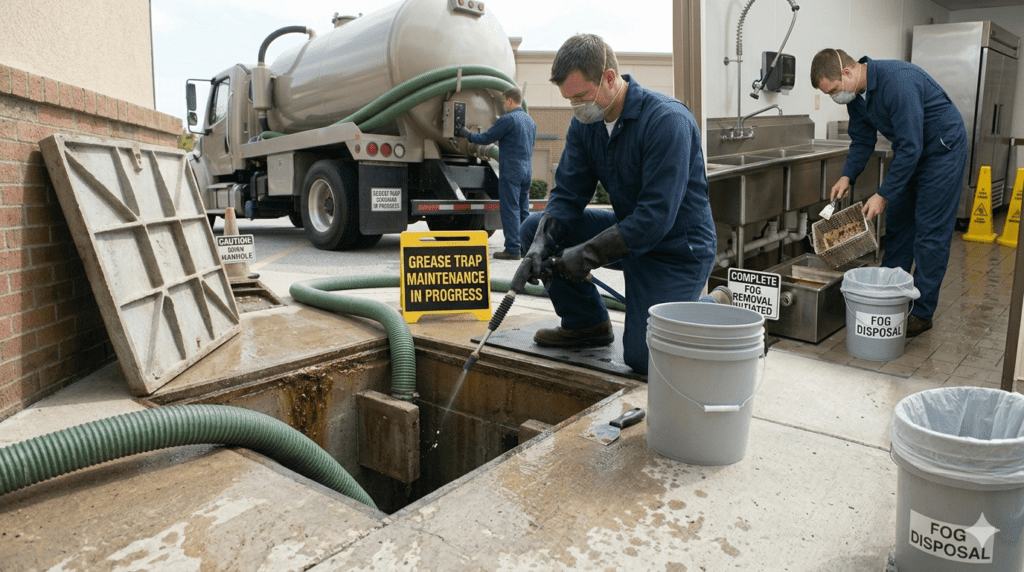
Many restaurant owners aren’t sure what they’re actually paying for when they schedule grease trap service. A professional cleaning involves several key steps:
- Inspection and measurement: A technician measures the grease and solids accumulation to assess the trap’s current condition and document compliance data for regular maintenance.
- Full pump-out: All liquid waste, grease, and solids are vacuumed out of the trap using a service truck with a holding tank.
- Scraping and cleaning: The trap walls, baffles, and lid are scraped and cleaned to remove adhered grease waste that can harden over time.
- System check: The inlet and outlet pipes are inspected for blockages or damage, and the trap’s components are checked to ensure proper operation.
- Waste disposal: All collected grease waste is transported and disposed of in accordance with environmental regulations. This is not something to cut corners on.
- Service documentation: You receive a manifest or service record for grease trap pumping, which is often required for compliance inspections and permit renewals.
This process typically takes between 30 minutes and a couple of hours depending on the trap size and condition.
Environmental Responsibility in a Sensitive Coastal Area
Key Biscayne sits on a barrier island surrounded by Biscayne Bay and the Atlantic Ocean, one of Florida’s most treasured coastal ecosystems. Restaurants operating in this community carry an added environmental responsibility that goes beyond basic compliance.
Grease and FOG that escape into the stormwater or sewer system don’t just create blockages. In coastal environments, they can contribute to nutrient pollution, oxygen depletion, and harm to marine habitats, including seagrass beds and coral ecosystems that support local wildlife and the tourism economy.
Regular grease trap cleaning isn’t just a regulatory checkbox here. It’s part of operating as a responsible local business in an ecologically sensitive area.
The Business Case: What Regular Cleaning Saves You
Let’s put this in perspective. A routine grease trap cleaning service in the Miami-Dade area typically costs between $150 and $500 depending on the trap size and service frequency. Compare that to:
- Emergency plumbing repair: emergency grease trap cleaning may be necessary to prevent further issues. $500 – $3,000+ can be the cost of grease trap pumping services, depending on the condition of your system.
- Health department fine for FOG violations: $250 – $5,000+
- Lost revenue from a temporary closure can be significant if plumbing issues are not resolved quickly. Thousands per day
- Reputation recovery after a public health citation may require immediate emergency grease trap cleaning and compliance documentation. Priceless
The math is straightforward. Routine grease trap maintenance is one of the most cost-effective investments a Key Biscayne restaurant can make.
Signs Your Grease Trap Needs Immediate Attention
Don’t wait for a scheduled service if you notice any of these warning signs of slow drainage or grease buildup:
- Slow drains throughout the kitchen can lead to major plumbing issues if not addressed promptly.
- Gurgling sounds from floor drains or sinks are often a sign of a clog in the plumbing system.
- Strong sulfur or sewage odors near the kitchen or dining area can indicate plumbing issues that need immediate attention.
- Visible grease buildup around drain covers may indicate the need for emergency grease trap cleaning.
- Recent grease trap overflow onto the floor
Any of these symptoms suggest your trap is at or beyond capacity and needs professional service right away.
Conclusion
For Key Biscayne restaurants, regular grease trap cleaning isn’t optional. It’s essential. It protects your plumbing, keeps you compliant with Miami-Dade County regulations, shields the local environment, and ultimately safeguards the business you’ve worked hard to build. The cost of proactive maintenance is a fraction of what you’d spend dealing with the fallout of neglect. More importantly, it gives you one less thing to worry about so you can focus on what matters most: running a great restaurant.
Ready to get on a reliable grease trap maintenance schedule? Contact Americlean Pumping today to speak with a local expert who understands the specific needs of Key Biscayne food service businesses. Whether you need a one-time pump-out or a recurring service plan, we’re here to keep your kitchen running clean, compliant, and worry-free.